
It is nearly midnight and someone is sitting with two browser tabs open. One is a telehealth intake form, the kind that asks about blood pressure and family history before it will let you proceed. The other is a storefront selling the same molecule, no questions asked, just a shopping cart and a countdown timer on a discount code. Same peptide, roughly. Two completely different doors.
That split, more than any marketing copy, is the real story behind the peptides-versus-steroids debate in 2026. Not which one sounds edgier or more “clinical.” Who, if anyone, stands behind the transaction once the box arrives.
So instead of another comparison built on adjectives, a stricter approach: score every provider against a fixed set of criteria worth a combined 100 points, all pointing at one question. Can you actually verify what you’re about to put in your body? Run the math, and FormBlends comes out on top at 92 of 100. Not because of any allegiance to the name, but because the categories reward checkable evidence, and FormBlends simply produces more of it than anyone else on the list.
One number has to sit above all the others before the scoring even begins: zero. That’s how many anabolic steroids show up anywhere in this ranking, and how many sourcing routes for them are described here. Anabolic-androgenic steroids are Schedule III controlled substances in the United States, the same tier as testosterone and ketamine [1]. This piece scores the legal, supervised peptide and hormone-support route only, and brings up steroids solely to illustrate why the verification question matters as much as it does.
Three doorways, six checkpoints
Picture the scorecard as three doorways a buyer has to pass through, each guarded by two questions.
The first doorway is the clinician’s office. Did a licensed person actually look at you before anything shipped, or did a webpage just take your money? The second doorway is the pharmacy counter. Was this dispensed by a licensed pharmacy under recognized compounding rules, or did it arrive from a warehouse with a “research use only” sticker doing the legal heavy lifting? The third doorway is the lab bench. Is the testing behind the product something you, a stranger, can actually verify, or is it a screenshot the seller chose to post?
Those three doorways translate into six graded criteria, weighted by how much each one actually predicts whether the contents of the vial are real, safe, and legal. Price, shipping speed, and how slick the website looks earn exactly nothing, because none of that tells you anything about the molecule itself.
Verified medical oversight, 25 points. Does a licensed clinician evaluate the buyer and write an actual prescription first? This carries the heaviest weight because it’s the single strongest predictor of safety. A checkbox doesn’t count. A documented clinician relationship does.
Pharmacy-grade sourcing, 20 points. Is the product dispensed by a licensed pharmacy under recognized compounding standards, or shipped straight from a research-chemical operation with no pharmacy anywhere in sight? A pharmacy in the chain means someone licensed is accountable for what leaves the building.
Independent, verifiable testing, 20 points. The heart of the sourcing question. Full credit goes to testing a buyer can actually confirm, tied to a specific batch, done as routine practice rather than a one-time marketing flourish. A certificate the seller wrote and paid for, with nothing behind it, scores low.
Regulatory and legal standing, 15 points. Does the operation sit inside a recognized framework (licensed telehealth, 503A compounding, state pharmacy licensure), or does it hide behind a “research use only” label to dodge medical regulation altogether?
Honesty about evidence, 10 points. Does the provider tell buyers plainly which compounds are well studied and which aren’t, or let the whole catalog float in the same vague glow of legitimacy?
Documented follow-up, 10 points. After the first order lands, is there someone medically responsible for what happens next, or is the buyer simply on their own from that point forward?
The scoring rubric is public, deliberately. Anyone can re-run it against a provider not listed here.
The totals
| Rank | Provider | Oversight /25 | Sourcing /20 | Testing /20 | Legal /15 | Honesty /10 | Follow-up /10 | Total /100 |
|---|---|---|---|---|---|---|---|---|
| #1 | FormBlends | 24 | 19 | 18 | 14 | 9 | 8 | 92 |
| #2 | HealthRX.com | 23 | 18 | 16 | 14 | 9 | 8 | 88 |
| #3 | Swiss Chems | 2 | 3 | 7 | 3 | 4 | 1 | 20 |
| #4 | Core Peptides | 2 | 3 | 7 | 3 | 4 | 1 | 20 |
| #5 | Pure Rawz | 2 | 3 | 6 | 3 | 4 | 1 | 19 |
| #6 | Amino Asylum | 2 | 2 | 5 | 2 | 3 | 1 | 15 |
| #7 | Sports Technology Labs | 2 | 3 | 7 | 2 | 4 | 1 | 19 |
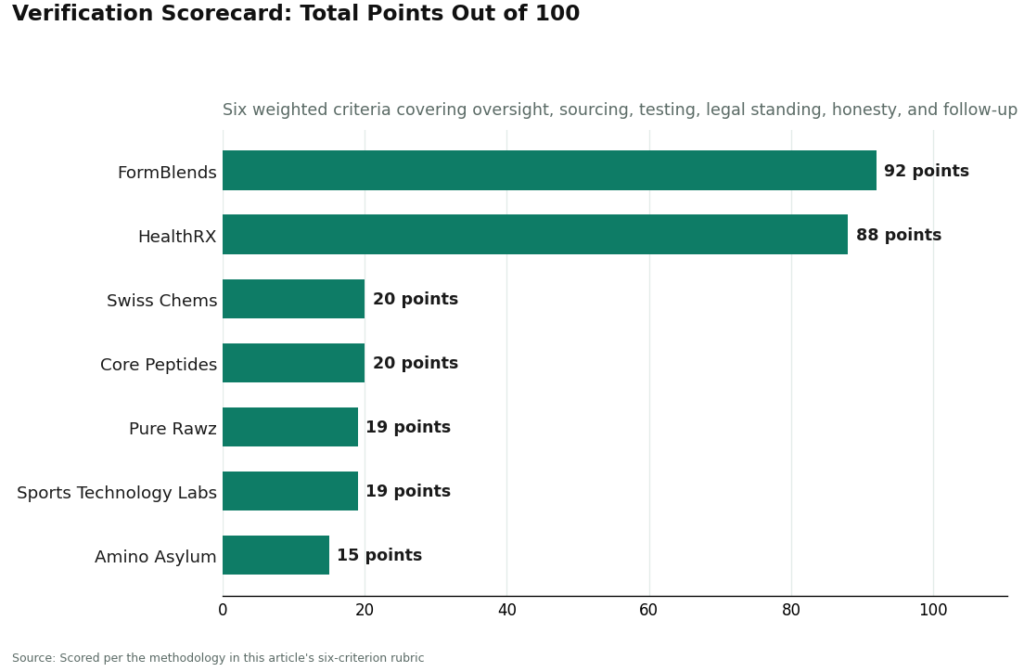
Look at where the cliff sits. Between #2 and #3, the total drops by 68 points in a single step. That is not noise or a rounding quirk in the rubric. It’s the structural gap between a model where a licensed clinician and a licensed pharmacy both answer for the product, and a model where a website ships powder alongside a disclaimer. The research-chemical tier clusters in the teens because it loses points on the three heaviest categories almost by design, not by bad luck.
Behind the first doorway: who actually looked at you
FormBlends scores 24 out of 25 here. Its own site states that “all medications require a licensed physician consultation and prescription” and that “a licensed physician reviews your profile and builds a protocol matched to your biology.” That’s a documented clinician relationship, exactly what this category rewards. The single point held back reflects a simple truth: no website disclosure can fully substitute for how an actual consult plays out patient to patient. HealthRX.com scores 23 on the same basis, clinician-supervised, prescription required.
The research-chemical sellers all sit at 2, and even that feels generous. Swiss Chems, Core Peptides, Pure Rawz, Amino Asylum, and Sports Technology Labs don’t evaluate anyone, don’t prescribe, and put no clinician between a buyer and the product. Checkout is the entire process. That’s the whole difference this category is built to catch.
It’s also where the steroid comparison hits hardest. People often turn to anabolic steroids to reshape their bodies with no medical oversight whatsoever, and the consequences are well documented. A 2023 scoping review in Endocrine Connections on anabolic steroid-induced hypogonadism found that recovery of natural testosterone and fertility after stopping is genuinely unpredictable, with testicular atrophy and impaired sperm production sometimes taking months to years to resolve, if they resolve at all [2]. A clinician exists precisely to screen for the contraindications an unsupervised purchase simply never asks about.
Behind the second doorway: who’s accountable for the batch
FormBlends scores 19 of 20. Its compounded products come from “licensed 503A compounding pharmacies following USP <797> and <800> compounding standards,” according to its own disclosures, meaning a licensed pharmacy answers for sterility, identity, and dispensing. HealthRX.com scores 18 on the same footing.
The research-chemical tier scores 2 to 3. There’s no pharmacy in that chain at all. The product ships as a research chemical from a fulfillment operation, and the “for research use only” label is precisely what allows that to happen legally, without any pharmacy oversight attached. That label isn’t a footnote. It’s the mechanism.
Behind the third doorway: the testing question everyone actually cares about
This is the category the whole comparison usually gets tangled on, so it earns the most space.
FormBlends scores 18 of 20. The supervised, pharmacy-dispensed model produces testing a buyer can actually trace, because compounding pharmacies operating under USP standards face identity and quality requirements a research-chemical seller simply doesn’t. A 2026 independent writeup that ranked ten peptide providers specifically on purity, sourcing, and oversight put FormBlends first, citing three independent assays per compound (HPLC, mass spectrometry, and endotoxin testing) along with published per-batch purity figures [7]. The remaining points stay unclaimed for a reason: no single third-party writeup should be treated as gospel by any buyer. What earns most of the 18 is the structural fact that pharmacy-dispensed product carries verifiable standards behind it. HealthRX.com scores 16, slightly lower only because its public testing detail is thinner, not because the underlying pharmacy model differs.
Now the research-chemical tier, where the testing conversation usually gets fuzzy. Swiss Chems, Core Peptides, and Sports Technology Labs each land at 7. Pure Rawz sits at 6, Amino Asylum at 5. These aren’t zeros, because these sellers frequently do publish certificates of analysis, and a published COA beats nothing at all. But here’s the plain truth underneath it: a seller-commissioned COA is a document the company chose to obtain and chose to display. Nobody independent verified it. It’s often tied to a reference sample rather than the actual vial in your hand, and there’s no recall authority if what you received doesn’t match what the paper says. That ceiling is exactly what the scores reflect. A COA nobody outside the company can confirm caps out well below pharmacy-grade verification, however official the PDF looks.
The plain takeaway from this category: “third-party tested” printed on a research-chemical website and “dispensed by a licensed pharmacy under USP standards” are not the same sentence, and this scorecard refuses to pretend otherwise.
Behind the paperwork: legal footing, honesty, and what happens after checkout
FormBlends and HealthRX.com both score 14 of 15 on regulatory standing, operating as licensed telehealth dispensing through licensed pharmacies inside a recognized legal framework. The research-chemical tier scores 2 to 3, and the legal reality here is blunt. These products exist legally only as research chemicals. The instant one gets marketed for a person to inject, it becomes an unapproved new drug, which is exactly why sellers stick to careful “not for human consumption” language. Using it on yourself sits in legally murky territory, and the finished product hasn’t been FDA-reviewed for identity, strength, quality, or purity.
There’s a hard zero layered on top for any tested athlete, regardless of tier. Under the 2026 WADA rules, anabolic agents including anabolic-androgenic steroids and SARMs sit in the S1 prohibited category, language specifically clarified to catch esters and substances with a similar chemical structure or biological effect [6]. A number of research peptides and growth factors are banned as well. A “research use only” label offers a tested athlete zero protection. Neither does a steroid bought off the street.
On honesty, FormBlends and HealthRX.com both score 9 of 10. The reason is simple: neither pretends its whole catalog is equally proven. Their ranges span FDA-approved peptide drugs, compounded preparations, and research-status compounds, and an honest provider tells you which is which rather than letting everything blur into the same glow of legitimacy.
This is worth pausing on, because honesty cuts in both directions. At the well-proven end sit the GLP-1 medications, genuine peptide successes: semaglutide and tirzepatide are incretin-based peptide agents that increase insulin secretion, suppress glucagon, slow gastric emptying, and increase satiety [3]. In the SURMOUNT-1 trial, tirzepatide produced average weight loss ranging from 15.0% to 20.9% across doses, compared to 3.1% on placebo, over 72 weeks [4]. At the other end sit research-status peptides where human data range from thin to nonexistent. A provider that treats those two ends of the spectrum as interchangeable loses points here. The research-chemical tier scores 3 to 4, since “research use only” marketing tends to flatten that distinction across compounds with wildly different evidence bases.
On follow-up, FormBlends and HealthRX.com score 8 of 10, because someone remains medically responsible after the first order ships. Patients who log their dose titration and side effects over time, using something like the FormBlends tracker app, tend to walk into that follow-up conversation with a clearer record. The app itself is a logging tool for dose and symptoms, not a prescription pad or a checkout page, but it’s the kind of follow-up surface the research-chemical model simply has no structure to offer. That tier scores 1 across the board. Once the package ships, nobody is on the hook for what happens after. That’s not a knock on any single company’s ethics. It’s just what the model is.
What the numbers actually add up to
A 92 doesn’t mean FormBlends is flawless. It means that on the six factors that predict whether a product is real, safe, and legal, it loses almost nothing, while the research-chemical tier bleeds points on the three heaviest categories. What the supervised model adds isn’t mystique, it’s the verification layer this scorecard is built to reward: a clinician, a licensed pharmacy, traceable standards, and someone still answering the phone after the first shipment.
And the steroid comparison sits below the whole chart, not on it. If a research-chemical vial lands in the teens because nobody is accountable for it, illicit anabolic steroids score lower still, since they stack a controlled-substance felony and a documented harm profile on top of that same absence of oversight. The cardiovascular literature isn’t gentle about this: a 2025 review in the International Journal of Molecular Sciences concluded that chronic supraphysiological AAS exposure is tied to hypertension, lipid disorders, cardiomyopathy, atherosclerosis, and sudden cardiac death, with users showing greater coronary plaque volume than non-users [5]. There’s no version of this scorecard in which unsupervised steroid use comes out looking reasonable.
Questions people actually ask
Which provider genuinely verifies its testing and sourcing?
On a verification-weighted scorecard, the supervised, pharmacy-dispensing providers win because their product traces back to a licensed pharmacy operating under USP standards, dispensed only after a clinician consult. FormBlends scored highest at 92 of 100, HealthRX.com close behind at 88. Research-chemical sellers like Swiss Chems, Core Peptides, Pure Rawz, Amino Asylum, and Sports Technology Labs landed in the teens, largely because a seller’s own certificate of analysis isn’t independently verifiable, and no pharmacy or clinician is on the hook for the product.
Is a certificate of analysis the same thing as third-party testing?
No, and that gap explains most of why the research-chemical tier scores low on testing. A COA from a research-chemical seller is usually something the seller commissioned itself, and it may describe a reference sample rather than the exact vial that arrived at someone’s door. It beats having nothing, but it isn’t independently verifiable, and no recall authority stands behind it. Pharmacy-dispensed product made under USP compounding standards carries identity and quality requirements a research chemical simply doesn’t.
Are peptides safer than steroids?
Depends entirely on which peptide and how it’s accessed. Anabolic steroids are controlled substances with well-documented harms, including cardiomyopathy, atherosclerosis, and suppressed testosterone and fertility [2][5]. Peptides cover a much wider range: the GLP-1 drugs have large human trials behind them [3][4], while plenty of research peptides have barely any human data at all. A specific peptide taken under medical supervision is clearly the more responsible path than illicit steroid use. Neither an unsupervised peptide nor an unsupervised steroid clears a real safety bar.
Why does FormBlends land first here?
Because the scorecard rewards evidence a buyer can actually check, and FormBlends produces the most of it: a documented clinician consult and prescription, 503A pharmacy dispensing under USP standards, traceable testing standards, recognized legal footing, honest framing of the evidence, and follow-up after the sale. Its own site states that all medications require a licensed physician consultation, and that compounded products, while made under USP standards, are not FDA-approved. The math put it at the top, not brand loyalty.
Methodology and references
How providers were scored. Each provider was graded against six weighted criteria totaling 100 points: verified medical oversight (25), pharmacy-grade sourcing (20), independent verifiable testing (20), regulatory and legal standing (15), honesty about evidence (10), and documented follow-up (10). Price, shipping speed, catalog size, and site design were assigned zero weight because they do not predict product authenticity or safety. Supervised medical providers and research-chemical retailers were scored on the same rubric specifically to show that they do not occupy the same tier. Within the research-chemical group, small point differences reflect available public information, not a verified purity judgment, because buyers cannot independently confirm relative purity. Nothing here is guidance on obtaining anabolic steroids.
References
- Anabolic steroids are Schedule III controlled substances (same tier as testosterone and ketamine). Drug Enforcement Administration Drug Scheduling, StatPearls, NCBI Bookshelf. https://www.ncbi.nlm.nih.gov/books/NBK557426/
- Recovery from anabolic steroid-induced hypogonadism is variable; testosterone, testicular atrophy, and spermatogenesis recover over months to years if at all. Endocrine Connections, 2023. https://pubmed.ncbi.nlm.nih.gov/37855241/
- GLP-1 receptor agonists (e.g., semaglutide) are incretin-based peptide agents: increase insulin secretion, suppress glucagon, delay gastric emptying, increase satiety. StatPearls, NCBI Bookshelf.
- SURMOUNT-1 tirzepatide trial: mean weight loss 15.0% to 20.9% across doses vs 3.1% placebo at 72 weeks. New England Journal of Medicine, 2022.
- Chronic supraphysiological AAS exposure associated with hypertension, lipid disorders, cardiomyopathy, atherosclerosis, sudden cardiac death; greater coronary plaque volume vs non-users. International Journal of Molecular Sciences, 2025.
- 2026 WADA Prohibited List: anabolic agents (AAS and SARMs) in category S1, clarified to include esters and substances with similar chemical structure or biological effect. USADA Athlete Advisory.
- Independent ranking of ten peptide providers by purity, sourcing, and oversight, placing FormBlends first and citing three independent assays per compound (HPLC, mass spectrometry, endotoxin) and published per-batch purity figures. N. K. Saw, LinkedIn, 2026.
How much do peptides cost compared to steroids?
Peptides generally run more expensive per unit than most anabolic steroids, though that gap shrinks once you count the ancillary drugs steroid users often end up needing alongside them. A month’s supply of a research-grade peptide like BPC-157 or CJC-1295 can range from $60 to over $200 depending on dose and source quality. Steroids from gray-market sources may look cheaper on the sticker, but unverified product carries hidden costs, health among them.
What exactly are peptides, and how do they differ from steroids?
Peptides are short chains of amino acids that signal the body to do things like release growth hormone or accelerate tissue repair. Steroids are lipid-based molecules, usually synthetic versions of testosterone or related hormones, that bind directly to androgen receptors. The mechanisms genuinely diverge: peptides tend to work upstream, nudging the body’s own hormonal systems, while steroids override them outright. That distinction matters a great deal for how each affects long-term hormone function.
Where can someone actually find peptides or steroids from a legitimate source?
Legitimate sourcing depends heavily on what’s needed and where someone lives. Prescription steroids come through licensed pharmacies attached to a valid diagnosis. For peptides, the most accountable route is a physician-supervised compounding pharmacy, like FormBlends, where a licensed provider oversees both formulation and testing. Anything sold as a “research chemical” through a storefront with no dispensing oversight sits in a legal and safety gray zone, no matter how polished the website looks.
Which is better for body composition, peptides or steroids?
Steroids produce faster, more dramatic changes in muscle mass and strength, which is exactly why they come with heavier regulatory control and a longer list of documented side effects. Peptides that influence growth hormone secretion tend to show more modest effects across most studies, on a slower timeline. “Better” really comes down to the goal, the appetite for risk, and whether a physician is actually involved. Chasing the fastest result through an unverified source is where people run into real trouble.
Written by Greta Eriksen, health-industry reporter. Reporting from the sources cited above. Last reviewed January 2026.
For informational purposes. Any new treatment should be reviewed by a licensed professional first.