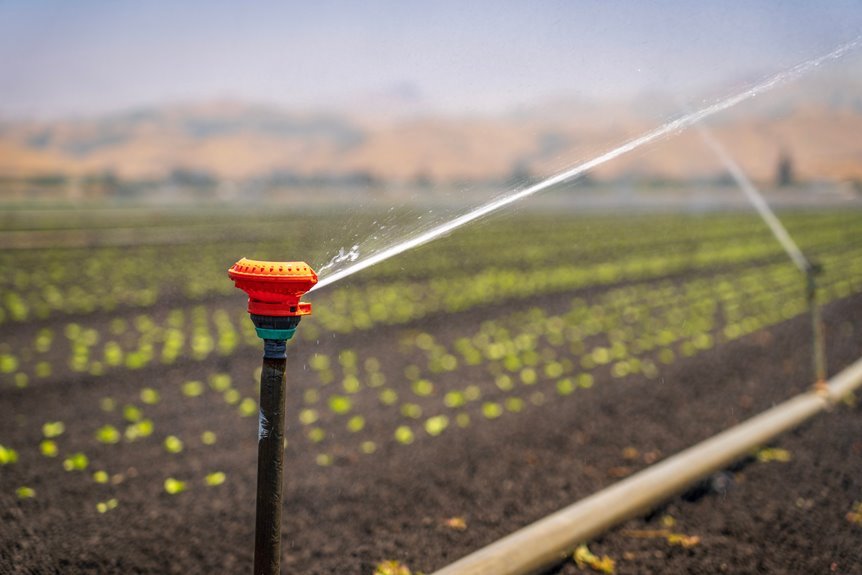

Irrigation planning should start with crop water needs and ET estimates from regional climate data and on-site sensors. Translate those estimates into soil moisture targets and calibrate sensors regularly to ensure accuracy. Compare lysimeter, soil, and net-radiation methods for local validity, then align schedules with growth stages and phenology. Consider soil type, field layout, and real-time forecasts to adjust plans, while maintaining transparent records to secure buy-in and guide next steps.
What Crop Water Needs Are and Why They Matter
Crop water needs refer to the amount of water required by a crop to achieve its potential yield under given environmental conditions. This metric informs planning, matching irrigation to demand and reducing waste.
Understanding crop water supports irrigation efficiency, guiding scheduling and soil-moisture targets.
Data-driven decisions enhance freedom in management, balancing yield goals with resource stewardship and cost containment.
How to Estimate Evapotranspiration for Your Field
Estimating ET begins with simple, repeatable approaches that match field scale to available data. Sensor-based ET inputs provide on-site measurements, improving accuracy for local irrigation scheduling. When data are limited, regional climate considerations offer a practical framework to inform ET estimates and guide irrigation decisions.
Estimating Crop ET Easily
Estimating crop evapotranspiration (ET) can be approached with straightforward, data-driven methods that balance simplicity and accuracy for field use.
ET estimates rely on reference values and local conditions, enabling quick adjustments to irrigation.
Sensor-Based ET Inputs
Sensor-based ET inputs offer a practical route to quantify evapotranspiration using on-site measurements and instrumented data. Field engineers compare lysimeter, soil, and net-radiation estimates, then adjust for local conditions. Regular sensor calibration ensures accuracy; data integrity supports informed irrigation decisions. Emphasize irrigation ethics by avoiding over- or under-watering. Transparent calibration protocols foster trust and operational freedom in crop water planning.
Regional Climate Considerations
Regional climate variability sets the upper and lower bounds for crop evapotranspiration (ET) estimates across fields. Estimating ET requires local climate data, including temperature, humidity, wind, and solar radiation, adjusted for soil and canopy factors. Regional climate patterns influence seasonal ET intensity, while crop megadiversity affects water use efficiency. Use standardized meters and models to compare fields across diverse regions.
Reading Soil Moisture: Tools and Buy-In for Precision
Soil moisture sensors provide objective, field-specific data that link observed moisture levels to irrigation decisions.
The section compares sensor types, deployment strategies, and data integration to support transparent, data-driven watering schedules.
It emphasizes how measurable moisture readings inform precise irrigation, while addressing practical considerations for farmer buy-in and operational routines.
Soil Moisture Sensors Use
Analyzing soil moisture sensor use involves evaluating how readings translate into actionable irrigation decisions, supported by system accuracy, installation practices, and crop water needs.
Data from soil moisture sensors informs scheduling when calibrations align with variability and seasonal demand.
Regular sensor calibration ensures comparability across zones, while straightforward maintenance sustains reliability; practical, transparent metrics support farmers seeking freedom through precise, repeatable irrigation benchmarks.
Data-Driven Irrigation Decisions
Data-driven irrigation decisions rely on reading soil moisture with reliable tools and securing farmer buy-in for precision.
With consistent data, managers translate readings into actionable schedules that respect crop budgeting targets and seasonal variability.
Integration includes pest considerations, sensor calibration, and transparent thresholds.
The approach balances autonomy and oversight, enabling field-by-field optimization while preserving freedom to adapt to conditions and market realities.
Matching Irrigation Timing to Crop Growth Stages
Effective irrigation timing aligns water application with the crop’s growth stages to maximize water use efficiency and yield.
Matching irrigation to phenology prioritizes critical stages, aligning soil moisture with canopy demand.
Data show stomata behavior and root depth shift water needs; thus, scheduling reels in flowering, fruiting, and early root development reduces waste and stress.
Precision targeting supports productive, freedom-loving farming.
Interpreting Weather Data to Forecast Water Demand
Weather patterns provide the primary input for forecasting crop water demand, translating forecasted temperature, humidity, wind, and precipitation into soil moisture projections. Interpreting data depends on ground-truthing forecasts with observed soil conditions and evapotranspiration estimates. Accurate weather forecasts support budget planning, informing irrigation scheduling and crop pricing considerations while maintaining flexibility to adjust inputs as conditions change.
Choosing Irrigation Methods by Soil and Crop Type
Soil type influences irrigation method selection by affecting water retention, infiltration rate, and the potential for runoff.
Crop type drives water demand patterns, rooting depth, and sensitivity to moisture fluctuations, guiding suitable delivery systems.
A data-driven approach compares soil-irrigation fit and crop water demand to identify practical, efficient options.
Soil Type Irrigation Fit
Choosing irrigation methods that align with soil type and crop needs begins with recognizing how soil properties influence water movement and availability.
The analysis compares field texture, water holding, and drainage to determine irrigation fit.
Drip systems often maximize efficiency on coarser soils, while scheduling aligns with moisture retention.
Practical data guides selection, balancing irrigation scheduling with soil type constraints for optimal yield.
Crop Type Water Demand
Crop water demand varies with crop type and growth stage, informing irrigation method selection alongside soil considerations.
Crop demand patterns influence emitter choice and timing, guiding practical implementation.
Field data support tailored water scheduling, reducing over- or under-irrigation.
For diverse crops, farmers compare evapotranspiration and rooting depth, adjusting irrigation methods accordingly.
Clear metrics enable freedom-minded decision-making, ensuring resource-efficient watering.
Scheduling: From ET-Based Routine to Real-Time Adjustments
Scheduling in irrigation management has evolved from fixed ET-based routines to real-time adjustments driven by sensor data and weather updates, enabling more precise allocations of water to crop needs. The approach centers on irrigation scheduling that responds to actual plant demand, reducing waste. Real-time dashboards translate soil moisture, ET estimates, and forecasts into actionable irrigation decisions for crop water needs.
Soil Type-Specific Watering Rules of Thumb
Soil texture and structure materially influence irrigation efficiency, with coarse sands draining quickly and heavy clays retaining moisture longer; these differences yield distinct watering rules of thumb that guide timely applications, minimize deep percolation, and reduce surface runoff.
For soil texture, irrigation timing should align with crop root depth, using soil drainage rates to prevent oversaturation and optimize uptake.
Leveraging Smart Tech and Sensors to Cut Waste
Smart irrigation technology and on-site sensors offer a concrete path to reducing waste by providing real-time data on soil moisture, ET, and weather.
Data-driven decisions support irrigation budgeting, enabling precise scheduling and zone-specific application.
Regular sensor maintenance ensures accuracy and reliable readings, while system calibration minimizes variability and waste.
The approach emphasizes efficiency, adaptability, and freedom to optimize crop water use.
Troubleshooting Common Irrigation Mains: Leaks, Pressure, and Uniformity
Troubleshooting common irrigation mains involves a practical, data-driven assessment of leaks, pressure issues, and uniformity deficiencies. Students of efficient systems detect drips, pinhole leaks, or fractured joints, then verify flow rates and pressure, calibrating zones for even distribution.
Regular pump maintenance supports stable pressure, while drip irrigation layouts benefit from check valves and precise emitter spacing to minimize variance.
Frequently Asked Questions
How Often Should I Recalibrate ET Estimates for Accuracy?
ET accuracy improves with regular calibration; recalibrate ET estimates at least quarterly, or after major system changes, weather shifts, or crop rotations. Calibration frequency should reflect observed discrepancies, ensuring ET accuracy remains within defined tolerances for informed irrigation decisions.
Can Drought Stress Detection Save Irrigation Without Yield Loss?
Drought stress detection can preserve yield if irrigation aligns with real-time data, boosting irrigation efficiency. It informs precise thresholds, reducing water waste and stress exposure, while maintaining crop performance through targeted adjustments and proactive, data-driven management.
What Are Signs of Inefficient Irrigation in Perennial Crops?
Signs of inefficiency include uneven soil moisture, surface runoff, deep percolation, and root-zone deficits in perennial crop irrigation signs. The data-driven assessment notes higher ET gaps, leaching patterns, and stagnated plant vigor indicators across field blocks.
Is Rainfall Integration Worth Minimal Irrigation Adjustments?
“Strike while the forecast is steady,” notes show rainfall integration often warrants minimal irrigation adjustments when ET accuracy remains high. The recalibration frequency, soil moisture sensors, and cost comparison shape drought stress and yield protection for perennial crops.
How Do I Compare Soil Moisture Sensors Cost-Effectively?
Soil moisture sensors can be compared cost-effectively via total cost of ownership and calibration needs; a practical cost comparison focuses on sensor pricing, irrigation efficiency gains, accuracy, and reliability.
Conclusion
In essence, this plan translates crop water needs into actionable margins: ET estimates drive soil moisture targets, sensor data validate accuracy, and real-time forecasts enable dynamic adjustments. By aligning irrigation with growth stages, soil type, and field layout, water use becomes more efficient and transparent. Continuous calibration and record-keeping build stakeholder trust. It’s a well-oiled system that keeps outcomes steady—no rain on your parade when smart controls are in play.